
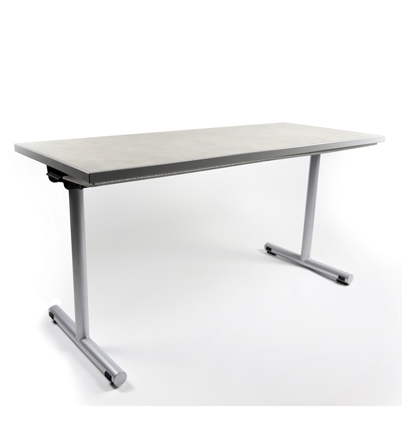


Technical Overview: PS Furniture Revolution® Folding Tables
The Revolution® Folding Tables manufactured by PS Furniture are engineered commercial tables designed for environments requiring frequent setup, reconfiguration, and storage. Their design focuses on reducing weight while maintaining structural durability, primarily through the use of a composite tabletop core and specialized edge construction.
Tabletop Construction
A defining characteristic of the Revolution® table line is the engineered composite tabletop core. Unlike conventional folding tables that typically use particleboard or MDF cores, this design uses a lightweight composite panel intended to reduce overall mass while maintaining structural rigidity.
The tabletop mass is approximately 1.7 lb/ft², which is significantly lighter than traditional particleboard or MDF table cores. This reduction corresponds to roughly a 66% decrease in weight compared with many conventional laminate folding tables of similar size.
Reducing the tabletop weight improves handling during room setup, teardown, and storage while still providing structural strength appropriate for commercial and institutional environments.
Surface Materials
The tabletop surface consists of high-pressure laminate (HPL) bonded to the composite core. High-pressure laminate is widely used in institutional furniture due to its resistance to abrasion, impact, and staining.
Laminate surfaces are typically available in multiple finishes and colors, allowing the tables to integrate with a variety of interior designs while maintaining a durable work surface.
The table edge profile is approximately 30 mm thick, contributing to structural rigidity and providing a finished commercial appearance.
Edge Construction
Revolution® tables incorporate a proprietary edge system called MAXX Edge®. This edge is formed by pouring urethane around the perimeter of the tabletop where it chemically bonds with the laminate surface and internal core.
This manufacturing process creates a seamless edge interface without exposed seams or joints. From an engineering perspective, the edge system is designed to:
- Improve resistance to impact damage
- Reduce the likelihood of edge delamination
- Eliminate small seams where moisture or debris could accumulate
The edge can be produced in different profiles, including eased (rounded) and linear (square) configurations.
Folding Base Design
The base assemblies are constructed from tubular steel legs with a folding mechanism designed to allow the legs to collapse beneath the tabletop for storage.
Many models include a positive-locking mechanism that secures the legs in either the open or folded position. In some configurations, a push-button release mechanism is used to engage or disengage the folding action.
Available base configurations include:
- T-Leg folding base
- Arched T-Leg folding base
- Square-leg folding base
- Flip-top nesting base (optional)
In flip-top configurations, the tabletop rotates vertically, allowing multiple tables to nest together for compact storage.
Footing and Mobility Options
The table bases may include several mobility and leveling features, such as:
- Recessed transport wheels on one side of the base
- Adjustable leveling feet for uneven floors
- Dual levelers or fixed feet, depending on the model
These features allow tables to be rolled short distances during room setup while maintaining stable support during use.
Optional Functional Components
Several optional components can be integrated with the table system to support modular configurations:
- Ganging hardware for connecting tables together
- Modesty panels for privacy in training or classroom settings
- Integrated power modules for conference and meeting applications
- Vertical storage carts for transporting and storing multiple tables
Storage systems can allow multiple tables to be stored vertically, reducing the floor space required when the tables are not in use.
Available Sizes
Revolution® folding tables are manufactured in several standard commercial sizes, including:
- 18″ × 60″
- 18″ × 72″
- 24″ × 72″
- 30″ × 72″
- 30″ × 96″
Standard table height is approximately 30 inches, which aligns with common meeting and workspace furniture dimensions.
Depending on size and base configuration, table weights typically range from approximately 29 pounds to more than 50 pounds.
Applications
Due to the combination of reduced weight and modular configuration, Revolution® folding tables are frequently used in environments where furniture must be moved or reconfigured regularly, such as:
- Training rooms
- Conference and meeting spaces
- Educational classrooms
- Event and banquet facilities
- Multi-purpose community spaces
Their design allows staff to reposition tables efficiently while maintaining durability suitable for repeated commercial use.
Product Link
For complete specifications, configuration options, and product details, visit the official product page:
https://www.psfurniture.com/product/revolution-folding-tables-2/
