Analysis of PS Furniture’s Scissor® Tables
Analysis of PS Furniture’s Scissor® Tables: Design and Applications
Introduction
Space constraints and safety concerns in furniture deployment are persistent challenges in environments like offices, healthcare facilities, and educational institutions. PS Furniture’s Scissor® Tables, with their fold-in-half design and integrated safety features, aim to address these issues through innovative engineering. This analysis evaluates the tables’ design, functionality, and suitability for space-limited settings, comparing their performance to industry standards and identifying potential limitations.
Design and Engineering
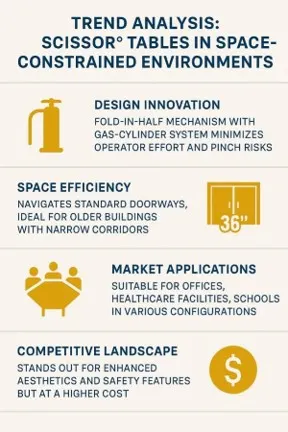
The Scissor® Tables feature a fold-in-half mechanism powered by a patented gas-cylinder system, likely nitrogen-based, which enables smooth folding and unfolding with minimal operator effort. This design contrasts with traditional hinge-based folding tables, which often require greater force and pose pinch risks. The tables are constructed with lightweight materials—potentially aluminum or high-strength polymer frames paired with Wilsonart laminate surfaces—balancing portability and durability.
While the gas-cylinder system enhances usability, its long-term durability and maintenance requirements remain unclear. Data on load capacity, stress testing, or the lifespan of the cylinders would strengthen claims of reliability in high-use settings. Compared to simpler mechanical hinges, the gas-cylinder mechanism may increase manufacturing costs, a factor facilities managers must consider against budget constraints.
Space Efficiency
The Scissor® Tables are designed to navigate standard 36″ doorways, addressing a key limitation of traditional fold-and-roll cafeteria tables, which often require 48″ or wider clearances. This makes them suitable for older buildings or facilities with narrow corridors, such as hospitals or schools. When folded, the tables likely have a compact footprint (e.g., approximately 48″ x 24″ x 10″ for a rectangular model), though exact dimensions are not provided. However, in extremely confined storage areas, such as small closets, the folded size may still pose challenges. A comparative analysis of folded and unfolded dimensions against competitors like Lifetime Products or KI Furniture would clarify their space-saving advantage.
Safety and Ergonomics
The gas-cylinder folding mechanism eliminates pinch points by controlling the folding motion, reducing injury risks in line with OSHA guidelines for workplace safety. This is particularly relevant in high-traffic environments like healthcare facilities, where staff safety is paramount. The design also prevents debris accumulation between table halves when folded, enhancing hygiene in settings requiring frequent cleaning, such as hospitals or food service areas.
However, the maintenance needs of the gas-cylinder system, such as potential pressure loss over time, are not addressed. Compared to traditional hinge-based tables, the Scissor® Tables likely offer ergonomic benefits, with setup times estimated at 30–45 seconds for a single operator (versus 1–2 minutes for bulkier designs). Quantitative data on weight (e.g., 40–60 lbs compared to 80–120 lbs for cafeteria tables) would further validate claims of reduced operator strain.
Configurations and Applications
The Scissor® Tables are available in eight configurations to accommodate diverse use cases:
- Round: 60″ (suitable for small group discussions)
- Hexagon: 60″ (ideal for collaborative settings)
- Square: 48″ x 48″ (compact, but limited for larger groups)
- Oval: 48″ x 79″ (effective for training or boardrooms)
- Rectangle: 30″ x 72″, 30″ x 96″, 48″ x 72″, 48″ x 96″ (versatile for conferences or classrooms)
This range supports varied room layouts, from break rooms to multipurpose spaces. The oval and larger rectangular options maximize seating capacity, while the square table may be less practical for gatherings exceeding 4–6 people. Aesthetic customization, including Wilsonart laminates and logo sublimation, ensures visual consistency across professional environments. However, highly irregular spaces or specialized needs (e.g., extreme weight capacities) may require custom solutions not offered in this lineup.
Comparative Analysis
Compared to competitors like Lifetime Products or KI Furniture, Scissor® Tables stand out for their gas-cylinder mechanism and aesthetic flexibility. Lifetime’s folding tables, for example, prioritize affordability but often lack advanced safety features or professional finishes. KI Furniture offers similar portability but may not match the Scissor® Tables’ doorway compatibility or customization options. However, competitors’ lower-cost models may appeal to budget-conscious buyers, potentially at the expense of durability or safety. A lifecycle cost analysis, factoring in maintenance and replacement frequency, would provide clearer insight into the Scissor® Tables’ value proposition.
Conclusion
PS Furniture’s Scissor® Tables offer a robust solution for space-constrained environments, leveraging a gas-cylinder folding mechanism and lightweight construction to enhance portability and safety. Their diverse configurations and aesthetic options make them suitable for offices, healthcare, and educational settings. However, the higher cost of the gas-cylinder system and lack of published data on load capacity, maintenance, or long-term durability warrant further scrutiny. Facilities managers should weigh these factors against operational needs and budget constraints. Future iterations could explore motorized folding mechanisms or sustainable materials to align with emerging industry trends.